Thaden is a tiny village on the wooded heath, only about three kilometres south of Hanerau-Hademarschen. What it lacks in size it more than makes up for in history: in Thaden’s woods and on its hills lie a remarkable number of megalithic tombs and burial mounds from the Stone Age. Add to that a coat of arms full of meaning, a quiet meadow landscape and one of the loveliest village tales in the region. From our guesthouse in Liesbüttel you are there in just a few minutes.
Proud village of Thaden
inhabitants
These the people of Thaden count quite precisely. Only one small green creature once threw them off: nobody could tell what it was, and the frog went down in history as a piece of village folly, complete with a mocking poem.
Thaden at a glance
- A municipality in the district of Rendsburg-Eckernförde, central Holstein
- Around 238 inhabitants across about 12 km² of heathland
- Highest point 22 metres, crowned by a striking burial mound
- Hamlets of Batz, Jarsdorf, Katzheide, Osterholzteich and Quistenhof
- Only about 3 kilometres from Hanerau-Hademarschen
- First documented mention in 1576
Megalithic tombs and burial mounds: Thaden’s Stone Age treasures
In a patch of woodland on Jarsdorfer Straße lie four megalithic tombs. They are among the oldest traces in the region and lead right back into the Stone Age. A quiet, history-laden place off the beaten track.
Thaden has around 35 registered archaeological monuments, including more than 30 burial mounds as well as megalithic tombs and long barrows. Such density is unusual for so small a place and shows that this heath was settled thousands of years ago.
On the highest rise in the municipality, around 22 metres above sea level, sits a striking prehistoric burial mound. It shapes the landscape so strongly that it even made it into the coat of arms.
History: from the Himpten to the green creature
Thaden first appears in a document in 1576, in the church register of neighbouring Schenefeld. Back then the farmers of Thaden had to deliver grain to the church, measured in the old corn measure called “Himpten”. This is exactly the story the coat of arms tells: a green hill for the many burial mounds, a golden Himpten for the grain deliveries and three green beeches for the wooded heath. In 1841 the village was home to 210 people, with eleven farms, craftsmen and a school for 59 children.
Thaden became famous, however, through a different story. According to legend the people of Thaden were once seen as “village simpletons” because they could not identify a small green creature, a frog. The poet August Kopisch, whom many know from the “Heinzelmännchen”, turned it into the mocking poem “The green creature and the naturalist”. To this day it is one of the most charming village tales on the whole heath.
Nature, water and trails
The river Hanerau runs through Thaden, at first still as a small brook. Only at the neighbouring village of Hanerau is it later dammed into the well-known mill pond. In Thaden it accompanies you as a quiet watercourse through meadows and water meadows.
Thaden lies in the middle of a gently rolling, wooded heath landscape. Sandy soils, woods and meadows shape the scene, ideal for quiet walks far from the crowds.
Riding and cycling trails lead through the quiet heath, right through woods, meadows and water meadows. A lovely area to explore on horseback or by bike.
Leisure in Thaden
Thaden has its own football pitch, even though there is no club of its own. Ideal for a casual kickabout in between.
In the hamlet of Batz lies the village’s central leisure area with a heated open-air pool and a riding hall. In summer this is where the village comes together.
Despite its size, Thaden is lively: there are a gymnastics club, an angling club and a nature conservation club, among others. Traditional festivals such as ice boules, the shooting match and the lantern procession bring the village together.
Worthwhile destinations nearby
The neighbouring village with traces of Theodor Storm, the Hanerau estate and a working watermill. You will find all its sights on our own place page.
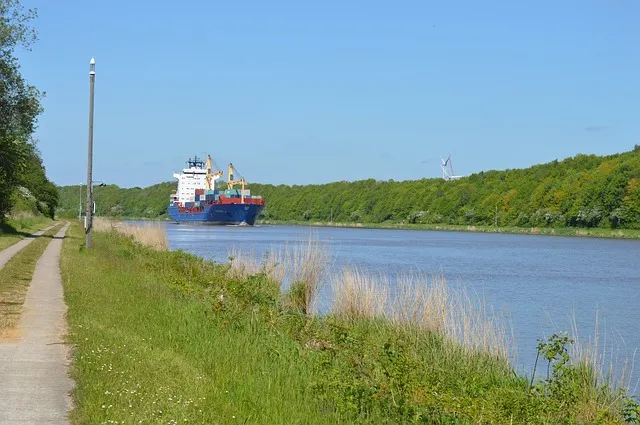
The Kiel Canal lies just north of Thaden. At Fischerhütte you can see the big ships up close and cross for free.
If Thaden’s burial mounds leave you wanting more, here is an archaeological open-air museum with reconstructed Stone Age settlements and megalithic tombs.
The best-known megalithic tomb in the region, with the largest capstone in Schleswig-Holstein, freely accessible in a grove of lime trees.
The mighty railway high bridge with its suspended transporter ferry is a technical landmark on the canal.
Frequently asked questions
Where is Thaden?
How many inhabitants does Thaden have?
Are there megalithic tombs in Thaden?
Where are the megalithic tombs in Thaden?
What is special about the burial mound on the highest point?
What does the Thaden coat of arms mean?
What is the story of the green creature?
How old is Thaden?
Is there a school in Thaden?
Is there a football pitch in Thaden?
What is the Batz leisure area?
Is Thaden good for walking or riding?
Are there animals to see in Thaden?
What festivals are there in Thaden?
What can you do in Thaden with children?
Is Thaden worth a visit with a dog?
How do I get to Thaden?
Which hamlets belong to Thaden?
How high is Thaden?
Is it worth visiting even though Thaden is so small?
What can you do around Thaden?
Where can I stay nearby?
Stay nearby
Would you like to explore the quiet heath and its Stone Age treasures at your own pace? Our guesthouse in Liesbüttel is just minutes away, with a hearty breakfast and first-hand tips.
Send an enquiry →